Topping Dx5 Ii vs Jlab Go Party: Which Should You Buy?
I've been living with both the Topping Dx5 Ii and the JLab Go Party for several months now, using them in very different scenarios: the Dx5 Ii as my desktop DAC/headphone amp and the Go Party as my go-to portable speaker for backyard hangouts and quick kitchen dance sessions. I bought both with my own money, and what follows is a detailed, candid account of how they performed in real life — the things I loved, the things that annoyed me, and the use-cases where each one really shines.
Why I picked these two
My audio needs split into two camps: clean, revealing sound for headphones and desktop listening, and a fun, robust speaker that I could take outside or leave on the counter. The Topping Dx5 Ii appealed because Topping has a reputation for transparent DACs and competent headphone amplification at reasonable prices. The JLab Go Party looked like a budget-friendly party speaker option with big sound and portability. I wanted to see whether spending more on a dedicated desktop unit mattered, or if a portable party speaker could cover both roles in a pinch.
What I tested and how
Over about six months I rotated both through daily use. For the Dx5 Ii I used a mix of studio-recorded and streaming music, switching between wired headphones (planar and dynamic) and active speakers. For the Go Party I used Bluetooth with my phone, connected it to a laptop for video calls, and took it outside for small gatherings. I tested volume/headroom, clarity in vocals and instruments, bass control, connectivity stability, ergonomics, and long-term reliability. I also paid attention to noise floor, display/usability, and any reliability quirks that showed up after weeks of use.
Topping Dx5 Ii — My experience
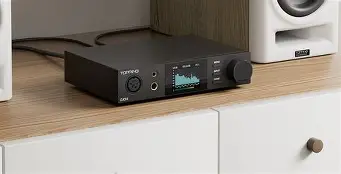
Out of the box the Dx5 Ii feels like a purposeful desktop component. It's compact, heavier than it looks, and has a satisfying tactile feel to its knobs and switches. The front panel gives me clear access to headphone outputs and its menu for input switching and filters is straightforward. I set it up on my desk, connected to my desktop and a pair of mid- to high-impedance headphones, and left it on most days.
Sound and performance
In my experience the Dx5 Ii is exactly what I hoped for: detailed, neutral, and very low-noise. It didn't artificially boost bass or treble. Vocals sat where they should in the mix; I could hear breath and subtle mic details that smaller, cheaper dongles often smooth over. With planar headphones it provided clean transient response and enough control to make the lows feel tight rather than flabby. With easier-to-drive dynamics, it simply made music more engaging without adding coloration.
One thing I noticed was the excellent silence between tracks — the noise floor was impressively low, which made quiet passages feel deeper and more immersive. I was also pleasantly surprised by the unit’s ability to drive slightly stubborn headphones to satisfying levels without audible distortion.
Discover deals on Audio & Headphones — updated daily.
See Deals →Build, usability, and features
The build quality is solid. The unit feels like it will survive casual knocks at a desk. The screen is legible and the front buttons let me toggle modes quickly. I appreciated the multiple output options: balanced headphone jack, single-ended outs, and pre-out for connecting to powered monitors. That made the Dx5 Ii versatile in my setup.
Where I was disappointed: the user interface is functional but not exceptional. Menu navigation is simple but can feel slightly clunky when switching settings frequently. Also, while the unit supports several digital inputs, switching between multiple connected devices isn't as instantaneous as I would like — there is a short pause while the input syncs.
What I appreciated and what bothered me
- Appreciated: Transparency and low noise floor — listening fatigue decreased, and I he…

Sound and performance
The first time I turned it on I was impressed by how loud it could get for its size. For pop and EDM it delivered a party vibe: punchy bass, upfront mids, and a bright top end that makes vocals and synths cut through. At low to moderate volumes the sound is enjoyable and energizing. At very high volumes, however, the speaker starts to lose refinement — the bass becomes less controlled and the highs can feel harsh on busy tracks.
One thing I found was that clarity for acoustic or jazz recordings wasn't the speaker's strong suit. Instruments lacked the micro-detail I enjoy when listening on headphones or a good stereo setup. But for its intended use — portable party audio — it excels in getting people moving and providing an engaging listening experience.
Build, portability, and battery life
The Go Party is plastic-forward in its construction, but it feels sturdy enough for casual drops and outdoor use. The handles and layout make it easy to move. Battery life in my tests was adequate for a typical evening: I regularly got several hours of mixed-volume playback before I needed to recharge. I wouldn't rely on it for an all-day event without a power source, but for backyard hangouts or impromptu jams it rarely left me wanting.
Find top-rated Audio & Headphones products at great prices.
See Deals →Bluetooth pairing with my phone was quick and stable in most situations. Occasionally, in crowded Wi-Fi/Bluetooth environments, I had to re-pair due to interference — not unusual for devices in this price range, but something I noticed. The speaker also has fun extras like lights and a microphone input, useful for karaoke or small announcements, though the mic channel is understandably tinny compared to a dedicated PA system.
What I appreciated and what bothered me
- Appreciated: Loud, energetic sound for parties; it gets people moving and fills small to medium outdoor spaces.
- Appreciated: Easy to transport and quick to pair with phones.
- Bothered: Not a refined listening device — acoustic nuance and instrument separation are limited.
- Bothered: At high volumes the speaker can sound congested and a bit harsh on complex tracks.
Comparison at a glance
Attribute Topping Dx5 Ii JLab Go Party Primary purpose Desktop DAC / headphone amp — focused listening and desktop audio hub Portable party speaker — casual, loud playback for gatherings Form factor Compact desktop unit (requires power/USB) Portable, battery-powered speaker with handle Sound signature Neutral, transparent, low noise floor Vivid, bass-forward, tuned for excitement over nuance Connectivity Multiple digital inputs, balanced and single-ended outputs Bluetooth primary, auxiliary and mic input options Headphone driving power Strong — suitable for higher-impedance cans Not applicable — speaker only Battery / portability Not battery-powered — best for static desktop use Battery-powered and easy to carry for events Best for Critical listening, home studio use, high-quality headphone listening Casual outdoor parties, portable music for groups, karaoke-style fun Price / value (subjective) Great value for desktop audiophiles who want neutrality Strong value for people who want loud, portable fun on a budget Pros & Cons — side-by-side summary
Topping Dx5 Ii
- Pros:
- Neutral, revealing sound that rewards good source material
- Very low noise floor — quiet listening experience
- Flexible outputs for headphones and monitors
- Solid build and desktop-oriented design
- Cons:
- Not portable — requires powered setup
- Menu navigation and input switching could be smoother
- More of an audio tool than a "fun" audio device
JLab Go Party
- Pros:
- Fun, energetic sound that performs well for parties
- Portable and battery-powered — easy to move around
- Simple pairing and useful extras like mic input and lights
- Good value for casual listeners and social use
- Cons:
- Not a detailed listening speaker — limited nuance for acoustic or classical music
- Can sound harsh or congested at high volume on complex tracks
- Build is plastic-forward and not as premium as desktop gear
How to choose — buying guide
When I was deciding between these two, the decision boiled down to what I actually do most of the time. Here’s how I’d advise you, based on the scenarios I tested.
Choose the Topping Dx5 Ii if:
- You're primarily listening on headphones at a desk or with a small speaker setup. I noticed the Dx5 Ii turned everyday listening into something more revealing and less tiring.
- You want a neutral, accurate sound for mixing, mastering, or critical listening. In my use it gave me a clear picture of the recording without artificial enhancements.
- You plan to connect multiple digital sources and benefit from balanced outputs. I liked using it as a hub between my PC and monitor speakers.
- You're serious about reducing hiss and background noise. The low noise floor made late-night listening much more enjoyable for me.
Choose the JLab Go Party if:
- You need portability and battery power for outdoor gatherings or quick on-the-go listening. I took it out to the yard multiple times and appreciated its convenience.
- Your main priority is loud, punchy sound that excites a crowd rather than perfect fidelity. The Go Party lives up to the “party” part of its name.
- You want extras like a mic input for karaoke or straightforward Bluetooth pairing with phones. I used the mic input a few times and it’s fine for casual use.
- You want strong value for a device that gets loud without breaking the bank. It’s not perfect, but it does exactly what it promises.
A few practical tips from my experience
- If you already have a solid headphone collection and use a desktop or laptop for music, the Dx5 Ii will be the most immediate upgrade.
- If you mostly stream music from your phone and want a speaker that’s easy to carry, the Go Party wins.
- Consider having both if your budget allows: the Dx5 Ii for focused listening and the Go Party for social situations. I found that combination covered all my bases.
- Try to audition with music you know well. I found my impressions of both devices changed when I listened to familiar tracks versus new ones.
Final thoughts and conclusion
After months of using both the Topping Dx5 Ii and the JLab Go Party, they remain very different tools that excel at different jobs. The Dx5 Ii is the quieter, more precise partner for desktop listening and headphone lovers — it revealed details I hadn’t noticed before and made long listening sessions more comfortable. The Go Party is the life-of-the-party: portable, loud, and designed to get the room moving, even if it sacrifices a bit of finesse to do so.
What I found was that neither product is inherently better than the other — they are better for their intended roles. If forced to pick one for my own life today, I’d keep the Dx5 Ii for daily, focused listening and studio tasks. But I’d also keep the Go Party for summer evenings and casual get-togethers because it reliably delivers the fun, portable sound I want in those moments. In my experience, knowing what you intend to use the device for is far more important than chasing a single "best" unit — both of these devices are exactly what they set out to be.